Our History


“Love is the hardest lesson of Christianity.”
- William Penn


A Short History of Reading Monthly Meeting

Although many Friends (Quakers) are known to have settled in Berks County as early as 1718 as part of William Penn's Holy Experiment, the plan for Reading Towne was not drawn until 1743 by an agent of Penn's son, Thomas.  Reading's first religious edifice, fittingly, was a Quaker Meetinghouse.  Some early historians mention a small log building as early as 1750, but its location is unknown.  (E. Michener says it was "on their burying ground" which would place it on Church Street directly behind the present building.)  It is known that the Court House was used for special Friends Meetings that were too large for a house or meetinghouse.

In 1759 lots #402 and #403 on Prince Street (now 106-108 N. Sixth Street) were purchased by the Quakers from the Penns and a small log building was erected from trees felled there.  A burial ground was also established.  Needing a larger Meetinghouse within a few years, Friends built a 'round log' structure at Queen and Thomas Streets (now 412 Washington Street) which was to serve them well for the 103 years.

In 1776 the pacifist Friends turned the Meetinghouse into a hospital for wounded Hessian soldiers who had been captured by the Continental Army at the Battle of Trenton (New Jersey).  One of the soldiers carved pictures into the woodwork, and this is part of the display you will find at the Meetinghouse today.

In 1787 the Quakers built a one-story log schoolhouse adjacent to their Meetinghouse which continued in operation until 1870.  In 1815 the Quaker schoolmaster took education with a religious emphasis to the county prisoners.  He found the venture so successful that he broadened the scope and started the first First Day School (Sunday School), an idea that spread rapidly to other meetings.

Responding to the need for a new, larger, permanent structure,  Friends built a stone structure in 1868 on the Sixth-Street site of the 1759 log Meetinghouse.  This is the building in which we worship today.  In keeping with the Quaker tradition of service this meetinghouse became, in addition to a house of worship, the Red Cross headquarters during World War I.  In 1920 the Red Cross added the annex to the building which, after that organization outgrew it, the Friends then made available to the Daniel Boone chapter of the Boy Scouts for their headquarters.

Later this building continued its multiple roles.  Refugee Lutheran Latvians met here regularly during the 1960's and 70's.  The Rehab Workshop, an independent project for handicapped persons, used the premises for many years  Other groups whose ideas are in harmony with the Quaker belief that "there is that of God in every man" to seek and discover, use the Meetinghouse from time to time.

Until September 1971 venerable with age, was an elm tree, scion of the tree under which William Penn concluded his famous treaty with the Indians - the only treaty of its kind, unbroken still.  Symbolically it stood as a reminder that all people are brothers, and that the future will be bright in proportion to the ability of individuals to love one another.

... compiled by Janet E. Norton, May 1972 with an update May 1995

A Short History of Maidencreek Meeting

Although William Penn arrived in America over 300 years ago (October 24, 1682), a third of a century passed before any settlers began to move into what is now Berks County.  In 1718 a few Quakers carved out farms in the fertile Oley Valley, built homes and began to hold religious services, first in their homes, then in a log meetinghouse they built themselves.  They worked hard, prospered and word of their successful venture spread.

 Within 15 years other Quakers, originally from Ireland and later from Chester County, Pennsylvania, came northward to settle near the Oley Valley (Old Exeter) Friends.  They liked the limestone soil of the virgin territory and the challenge of participating in Penn's Holy Experiment.  As the first white men to inhabit the Ontelaunee environs, they succeeded in building a trusting relationship with the resident Indians.  They held religious services, first as an indulged (not yet independent) meeting and then as a preparative meeting under the care of the Gwynedd (Philadelphia) Monthly Meeting, as early as 1732 in the home of Moses Starr.

Soon the Maidencreek Friends built a small log meetinghouse, followed shortly by a larger log meetinghouse located on land rented from the Lightfoot family near the Stone Bridge (now covered by  the waters of Ontelaunee Lake).  In 1737 this second settlement of Friends in Berks County became a part of the newly established Oley Meeting.  Thereafter, until the schism of 1827, monthly meetings for business were held alternately at Oley (Exeter) and Maidencreek.

The names of many of these early Quakers are easily recognized in the area today - Parvin, Wiley, Pearson, Willits and Wright, to name a few.  Their influence in the community as the primary governmental administrators lasted until after the Revolutionary War and produced prominent justices, commissioners, sheriffs, coroners, etc, as well as a substantial and principled citizenry.   When Berks County was established in 1752, almost all of the land in Maidencreek Township and much of Windsor and Richmond Townships, was owned by the seventy families who belonged to Maidencreek Meeting.

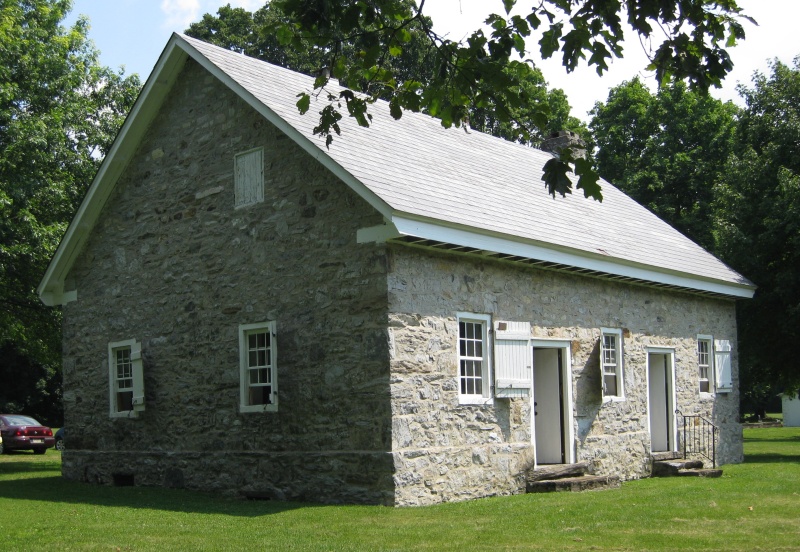
Maidencreek MeetinghouseIn July 1759 a little over four acres of ground was purchased from Benjamin Lightfoot and the present 1 1/2 story gray stone meetinghouse was erected and a  burial ground established.  Worship services continue in that house to this day (primarily during the summer months) though there was a period between 1910 (after the death of Deborah and James Meridth) and 1950 when it was not used.  For 167 of those years it remained on the original acreage in the valley until its removal and rebuilding on the present site to accommodate the need of the City of Reading for a reservoir.

Always alert to the educational needs of their families and neighbors, Friends built a log school house adjacent to the meetinghouse in 1784.  They replaced it in 1807 with a gray limestone building which was used as a school until at least 1870.  Officially it appears to have been closed in that year.  Unofficially, based on the 1965 recollections of an elderly woman, now believed dead, who claimed to have attended classes there as a child, it may have functioned as a school as late as 1900.  What is clear is that in 1926 the school house became a caretaker's cottage, after it, the meetinghouse, and the 700 re-interred bodies from the old cemetery had been moved to their present location.

The site chosen for relocation is next door to another old meetinghouse that has since 1934 been a private residence.  Known as the 'Kindt's Corner Brick Meetinghouse', it was built in 1853 by Orthodox Quakers who did not accept the religious - called Hicksite - ideas espoused by most Maidencreek Friends in a theological schism in 1827.  In a relatively cordial dissent, they were joined by other Orthodox Friends from Reading Meeting, renting a log house on the Reber farm for 26 years for their worship services.  They continued to share the old burying ground and school with the Hicksites.  The brick meeting house was used until 1910 when, because of diminishing numbers, Friends chose to gather for worship in private homes.

During the early 1950's, the Orthodox and Hicksite Friends in the Reading area united, ending the long and unfortunate separation.  Though outwardly changed in dress and manner from those early Quakers who came to Berks County, Friends today are aware that William Penn - a practical politician as well as a great visionary - was wise in his observation that "Love is the hardest lesson of Christianity."  Together, Friends strive, as did their forbears, to find "that of God" which they believe lives in every man.
Janet E. Norton, October 1975
 
Pictures of Maidencreek Meetinghouse at Caln Quarter web site